
Como se diz?
How and why I use Ai to create songs. Como uso a IA para criar canções — e porquê.

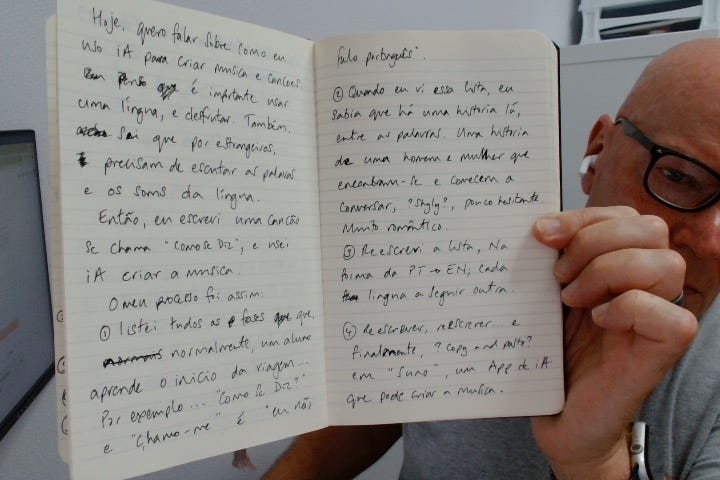
Hoje quero falar sobre a forma como uso a IA para criar música e canções.
Subscribe and join in.
Penso que é importante usar uma língua e ter prazer em usá-la. Também sei que quem está a aprender uma língua precisa de ouvir as palavras e os sons dessa língua.
Por isso, escrevi uma canção. Chama-se «Como se Diz?» e usei a IA para criar a música.
O meu processo foi o seguinte:
Fiz uma lista das frases que um aluno costuma aprender no início da aprendizagem, por exemplo: «Como se diz?», «Chamo-me...» e «Eu não falo português».
Quando vi a lista, percebi que havia ali uma história, escondida entre as palavras: a história de um homem e de uma mulher que se conhecem e começam a conversar timidamente, ainda um pouco hesitantes. Podia ser uma história muito romântica.
Reescrevi a lista em formato bilingue, com cada frase em português seguida da tradução em inglês.
Depois, reescrevi, voltei a reescrever e, finalmente, copiei e colei tudo no Suno, uma aplicação de IA capaz de gerar música.
Em inglês:
Today I want to talk about how I use AI to create music and songs.
I think it is important to use a language and enjoy using it. I also know that language learners need to hear the words and sounds of the language they are learning. [I could go on at length about this - but trust me, if your course starts with learning how Portuguese words and letter combinations sound, then they are saving you much time later trying to unlearn English sounds and their spellings. It is also one reason why I stopped using Duolingo early on. More on that in another post.]
So, I wrote a song. It is called “Como Se Diz?” and I used AI to create the music.
My process was:
I made a list of the typical words and phrases that a learner is told about at the start of their learning journey. Things like “How do you say?” and “ My name is…” and of course “I don’t speak Portuguese”.
When I saw the list, I knew there was a story hidden in the words: a story about two people who meet and (shyly) begin to talk. Perhaps it could be romantic, even.
I re-wrote the list with English and Portuguese on alternating lines.
Then, I re-write it several times until I [lost patience and] finally copied and pasted it into Suno - an AI app that generates music.
Here are the lyrics:
(Como se diz?)
(Como se diz?)
Quero dizer olá.
Quero dizer olá.
(I want to say hello.)
Mas eu não falo português.
(But I don’t speak Portuguese.)
Ainda estou a aprender.
(I’m still learning.)
Como te chamas?
Como te chamas?
(What is your name?)
(What is your name?)
Prazer.
Prazer.
(Nice to meet you.)
Igualmente.
(Likewise.)
E tu?
(And you?)
Falas inglês?
(you speak English?)
Talvez…
Talvez…
(Perhaps…)
(Perhaps…)
Como se diz?
(Como se diz?)
How do you say?
(How do you say?)
Não posso explicar.
(I cannot explain.)
O que eu quero dizer.
(What I want to say.)
Talvez…
Talvez…
(Perhaps…)
Talvez um dia.
(Maybe one day.)
Quero caminhar contigo.
(I want to walk with you.)
Mas faltam-me as palavras.
(But I’m lost for words.)
Talvez, talvez.
Talvez um dia.
(Perhaps one day.)
E tu?
(And you?)
Queres um café?
(Would you like a coffee?)
Pode ser.
Pode ser.
(That could work.)
(That could work.)
Eu sei o que queres dizer.
(I know what you mean.)
Não precisas das palavras certas.
(You don’t need the right words.)
Talvez, talvez.
Talvez um dia.
Como se diz?
(Como se diz?)
How do you say?
(How do you say?)
Não posso explicar.
(I cannot explain.)
O que eu quero dizer.
(What I want to say.)
Só quero dizer que gosto de ti.
Só quero dizer que gosto de ti.
(I just want to say I like you.)
(I just want to say I like you.)
Talvez
Talvez
Talvez um dia
(Perhaps one day)
Até amanhã?
(See you tomorrow?)
Claro que sim!
(Of course!)
Fa-la-la-la
Talvez
Fa-la-la-la
Um dia
Fa-la-la-la
Fala! Fala!
I could not resist the urge to push slightly beyond the very basic and include some of my favourite Portuguese expressions: não posso explicar and quero dizer; both which I urge new learners of Portuguese to consider using.
I find they help when I know I am about to produce some mangled, tortured expression that may not work (or may even offend).
Some friends introduced me to pode ser which is a lovely get-out-of-jail phrase but I also love its related partner, talvez, especially in the context of the song.
Here is a teaser:
If you want to hear “Como Se Diz?” then it is widely available on everything from YouTube to music servers I personally do not recognise. Anyhow, this link will take you to a list of links so you can choose how you want to listen:
If you want to try out Suno, you can do so here. I might even get some free brownie points (sadly, not dinheiro).
There are many AI out there. I have no idea which one is best.
There you have it. That is a very quick overview of how and why I used AI to make this song.
I have deliberately been brief because I want these posts to be of a sustainable length. But there is quite a bit more to the editing process of both the music and the lyrics than just click-and-wow. I think this song was one of the faster ones and it took about 6 hours. Some of that time was spent looking very carefully at the language in both EN and PT. For example, at one point I considered “Como-se diz?” to be echoed in EN as “How do I say?” or even “How can I say?” which are, to my idiomatic ear, more natural than “How do you say?”
One of the biggest problems I have had with learning a new language is the rigidity of interpretation offered by non-AI translation devices (dictionaries, apps and, yes, humans!) I might write more on this later, but essentially I have almost ended up in a fight over words like “andar” because the person I was speaking to has been told it means “to walk” … and so they refuse to allow for any other meanings.
Ai will tell you differently.
If you want to carry on this topic - hit me up with a message or send me a note or something.
Até breve, Malta!