
Plateaus, Dips and Going Backwards
The non-linear roller coaster of language learning.

Two days ago I was discussing the industrial revolution, economic migration and traditional songs sung in the fields of Portugal with a neighbour. Repara que - em português.
Today I am wondering if I can remember any of the language at all.
I blame this on the fact that I spent the last two days producing materials for a client in English. This required thinking heavily in English. I have to get back to some other EN based work in a few minutes, so I do not have the time to write this in português, either.
But I wanted to write something about this feeling of making forward and backward steps.
Firstly, plateaus. I think plateaus are natural and necessary, but you need to think a little about what kind of plateau it is. For example, there is the kind that comes as a result of just doing the same things over and over. The ‘complacency plateau.”
I have to say, as much as Duolingo helped me get started, I do feel it is guilty of trapping its users at a certain level. As do many apps and digital learning environments. And you do have to wonder if this is deliberate at times…
But that aside, consider a person who knows enough to order a coffee and a cake and say hello to the neighbours. They are probably very good at it. But they run the risk of being stuck on that plateau.
This is a comfort zone plateau. Kolb’s adult learning theories might describe this sort of palteau as happening when:
“The learner has conversations but rarely thinks afterwards about what worked, what repeatedly failed or what language was missing.
They are practising, but each experience disappears without being examined.”
But for anyone reading this, I am guessing this does not apply - i.e. you are concerned enough to be reading an article on it!
I am convinced my plateaus are resolved by doing something different. I might try (again) to find a podcast or a book that I both like and can understand. Incidentally, Substack itself has helped. It has many wonderful writers writing in Portuguese. I am very grateful for the opportunity to read clear, shorter, direct non-fiction. I would urge anyone feeling stuck NOT to go back to that book of verb tables, or exercise book, or Duolingo. After all, you know what they say about a person who does the same thing over and over and expects a different result….
This brings me to those times when I feel I am going backwards. Or regression, as Kolb would call it. Some of my regressions are very real. I am just not using the language enough or trying hard enough. I am going to make a wild guess that anyone not putting in at least 20 minutes every day / 2 hours a week is going to either stagnate or forget more than they are learning. You simply have to put the work in.
I also have ‘false regressions’. I had a reasonable handle on the perfect and imperfect tenses for a while, and now as I start to become over confident and try expressing the conditional, I find I am making more errors and feeling frustrated. My analysis of this is that my grasp of the imperfect tense is not fully embedded up stairs yet. I need to just stop and get back to a path that is a little less steep. I get regression fever when I open novels, too. Especially fiction. Anything dense. I get bogged down, bored and lost. Again, I just need to calm down a little.
This is not a ‘dip’. A dip is when I wake up, like I did today, and I have just been too immersed in my home language for too long. I haven’t actually lost any ground, I am just a few metres from the path I was on.
So, what to make from all this? My take on it is:
Firstly, keep trying. And do as much as you can as regularly as you can.
Keep reflecting on what is working, keep trying new things. Don’t go completely overboard. You need to push your comfort zone but don’t just butt your head off the sheer face of a mountain, either. Try listening to new things; try turning the subtitles off for a few minutes - putting them back on is not shameful, either. Try a different book or a different app or even a different tutor! Whatever works.
Secondly, if you are that way inclined, and you want to be a little more formal, you might try using Kolb’s adult learning cycle:
A practical Kolb cycle for language learning
E.g. Task: Learning to tell a story in the past: (but insert here any language task you feel you are ready to attempt)
Experience it:
E.g. Tell somebody what happened yesterday.
Reflect on it:
Where did you run into problems? What did the listener misunderstand? Which verbs or connecting expressions were missing?
Conceptualise the learning:
Identify one problem that was occurring regularly —perhaps switching between past perfect and imperfect, or gender agreements, or whatever.
Experiment:
Try asking someone (or an Ai) to help you with the problem. Then retell the story, or write a version of it, and see how you did.
Lastly, have you ever thought about your own language milestones?
There are plenty of systems that describe the linguistic capabilities of learners (CEFR, for example, describes progression levels like this:)
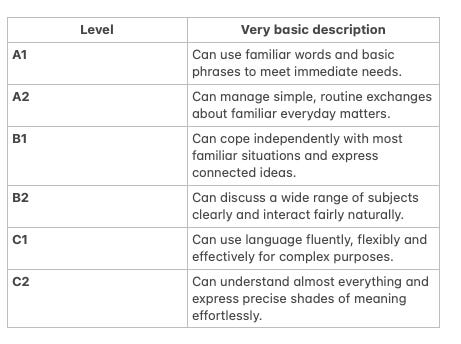
But these are not the same as milestones on the journey. Someone once told me that they knew they were doing better when they started having dreams in the target language. My son is convinced that the most essential thing is to consciously think in the target language. I believe this too.
One of my first milestones was being able to name all the desserts in a restaurant… and some of them I had no idea what the English might even be.
Similarly, a friend told me he always writes his shopping lists in português, and it was not long before his shopping vocabulary = >100% of his shopping lists. Now there’s a useful plateau to reach.
When I first arrived, 5 minutes of radio would give me a headache. I used to try and just pick out single words I recognised. Now I am disappointed if I do not understand what is being said - at least in gist, especially if it is a familiar or general context.
My personal list also includes the first time I managed to overcome the inherent difficulties of speaking with a delivery driver, handsfree, and the first time someone did not automatically say “ I will speak English. It is easier.” Both of which were real moments to celebrate.
These are the landmarks I passed on my journey. I think a journey is a better analogy for language learning than a ladder. It is not meant to be all upwards.
If you have the time, I would love to hear about your landmarks.